
The Gap Between the Headline and the Freight
The White House published a press release on April 22, 2026, titled “Trump Effect: American Manufacturing Is Roaring Back as Factory Activity Hits Four-Year High.” The ISM Manufacturing PMI did reach 52.7 in March 2026 — a multi-year high that signals genuine expansion in domestic manufacturing activity. The administration counts over 100 companies that have pledged to reshore or expand domestic production.
Here is what those numbers do not tell you.
IoT Analytics, which tracks manufacturing construction data from the U.S. Census Bureau’s Value of Construction Put in Place survey, published an analysis concluding that it is too early to characterize what is happening as a reshoring boom. Manufacturing construction spending excluding computer and electronic products — which is dominated by semiconductor fabs that generate relatively little trucking freight per dollar invested — rose approximately 5.6% between February 2025 and March 2026 in nominal terms. Adjusted for the 3.3% annual inflation rate as of March 2026, real growth in manufacturing construction was approximately 2.3%. Manufacturing employment has declined 1% since the widespread tariffs took effect, with only a slight uptick in the most recent data.
Meanwhile, the Kearney Reshoring Index, which measures year-over-year change in the U.S. manufacturing import ratio, shows that while 2025 was modestly better than 2024 for domestic production share, the U.S. remained well below the levels that would indicate a structural reshoring trend. And a December 2025 Institute for Supply Management survey of companies found that 64% had no plans to reshore operations — compared to only 36% planning to or actively doing so.
The freight reality that a carrier needs to understand is this: there is no across-the-board manufacturing boom generating a rising tide of new domestic freight. What there is — and what is directly actionable right now — is a specific set of industry sectors where domestic production investment is real, already underway, and generating truck freight that is not yet fully locked into routing guides. Those sectors are pharma, food and beverage, flatbed-adjacent construction materials, and regional automotive supply chains. Each one moves differently, requires different positioning, and rewards different kinds of carrier preparation.
Pharmaceutical: The Sector With the Most Freight Already Moving
Pharmaceutical manufacturing is the sector where reshoring is most concretely real and where the freight implications for regional carriers are most immediate. Eli Lilly announced a $27 billion domestic manufacturing investment plan that includes facilities in Indiana, North Carolina, Wisconsin, and Alabama. The Alabama facility broke ground in 2026 as part of that plan and represents one of the largest pharmaceutical manufacturing investments in that state’s history. Merck has an active domestic vaccine and biologics manufacturing program. Johnson & Johnson announced a $55 billion domestic manufacturing pledge in 2025, with production expected to ramp across a five-to-seven-year timeline.
The freight profile of a pharmaceutical manufacturing facility is specific and worth understanding precisely. Large pharmaceutical plants do not generate enormous volumes of outbound truckload freight the way a consumer goods distribution center does. What they generate is a consistent, high-frequency movement of regulated inputs, controlled substances, packaging components, and finished product — much of it temperature-sensitive, much of it requiring chain-of-custody documentation, and much of it moving on short regional lanes between facilities, distribution points, and specialty logistics hubs. This is not dry van spot freight. This is relationship-dependent, compliance-intensive, high-value-per-mile freight.
For a carrier positioned to move pharmaceutical freight — which requires understanding temperature requirements, chain-of-custody documentation, facility access protocols, and the compliance infrastructure that a pharmaceutical shipper demands before awarding a lane — the barrier to entry is real. But the barrier functions as a moat, not just an obstacle. Every compliance requirement that a small carrier meets is one that a less-prepared competitor cannot match. The carriers who invested in the carrier packet, safety record, and direct shipper outreach process described in previous articles on this platform are the ones who can walk into a pharmaceutical logistics conversation and present themselves credibly. The ones who have not done that work cannot get in the door.
The practical first step is geographic. Identify which pharmaceutical manufacturing facilities — including existing ones and announced expansions — operate within a 300-mile radius of your home base. The Reshoring Initiative’s database at reshorenow.org tracks announced domestic manufacturing projects by state and industry. Cross-reference that against your operating region and you will have a list of potential accounts that most of your competitors have never contacted.
Food and Beverage: The Sector Where the Freight Is Already There
Food and beverage manufacturing generates more domestically rooted truck freight than almost any other sector, for a straightforward reason: food cannot be offshored the way a circuit board can. The inputs are agricultural, the processing is regional, and the distribution is time-sensitive. What has changed in the current environment is not that food manufacturers are suddenly reshoring — they were always domestic — but that the combination of supply chain instability, tariff pressure on imported ingredients and packaging, and shifting distribution patterns is driving new facility investment and routing changes that create fresh freight opportunities.
C.H. Robinson’s December 2025 freight outlook noted that food and beverage produce and beverage seasons typically drive Q2 rate increases starting from a higher base than in recent years, with shippers in that sector actively evaluating carrier relationships heading into the seasonal surge. The Southeast, which saw capacity tighten significantly through 2025 due to carrier exits combined with steady food and beverage manufacturing activity, is a region where small carriers with consistent, documented service records on regional lanes are worth real money to shippers who cannot afford disruption on temperature-sensitive or just-in-time food distribution runs.
The food and beverage opportunity for small carriers is not in the national networks that run product from major processing plants to national distribution centers — those lanes are largely controlled by large carriers with dedicated routing guide positions. It is in the regional middle tier: moving raw agricultural inputs to processing facilities, shuttling finished product between co-packing facilities and regional DCs, running specialty and artisan food products that move in lower volumes and need flexible scheduling. These are lanes that a one-truck or three-truck operation can service consistently and win direct relationships on, because the shippers running them are often mid-sized food manufacturers who cannot get attention from a large carrier and do not want to be permanently dependent on broker spot freight for their primary production inputs.
The specific move: contact food processing facilities, dairy operations, and beverage manufacturers in your region directly — not through a broker. A regional dairy cooperative with three plants within 150 miles of each other needs a reliable carrier for interplant transfers and outbound distribution more than it needs a national carrier’s routing guide. A specialty food manufacturer shipping to regional grocery chains needs a carrier who can handle short-notice pickups and consistent temperature management. These are the conversations that build the kind of freight relationship the platform’s shipper outreach articles describe — and food and beverage is the sector where that approach has the shortest path from first call to first load.
Flatbed and Construction Materials: The Infrastructure Freight That Is Already Running
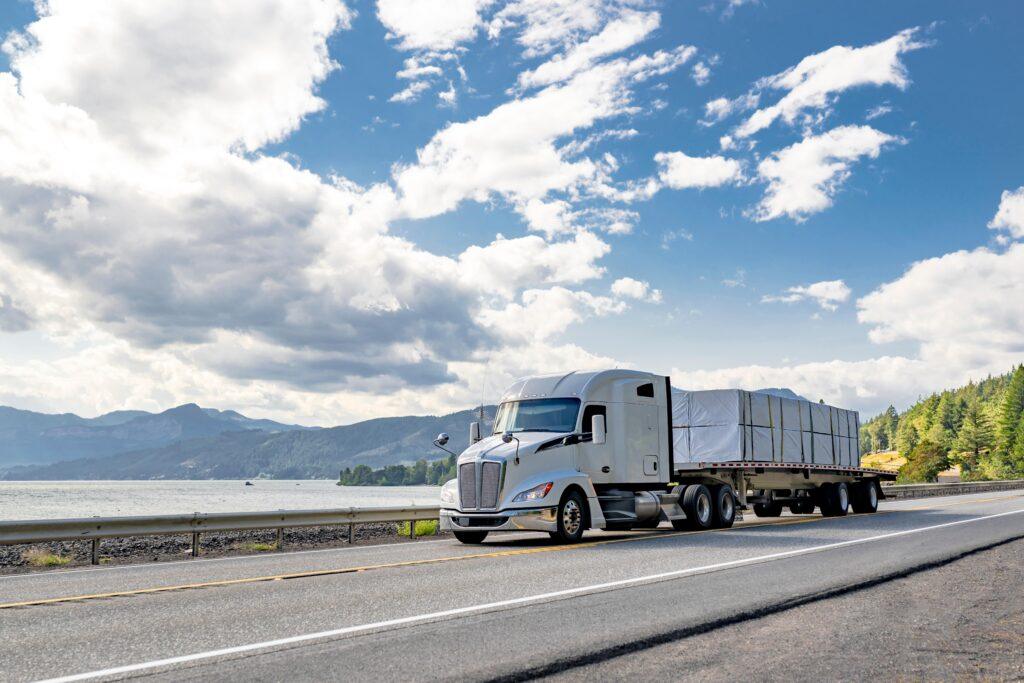
The U.S. infrastructure investment cycle is generating steady flatbed freight that is structural — driven by long-term federal funding commitments rather than consumer demand cycles — and that creates a freight profile most favorable to carriers who can position as reliable regional flatbed capacity rather than chasing spot loads on the open board.
S&P Global’s Regulatory Research Associates forecasts approximately $1.3 trillion in aggregate U.S. energy utility capital expenditure between 2026 and 2030, driven primarily by data center demand and grid expansion. Manufacturing facility construction itself — the physical building of the new plants that are either reshoring production or expanding domestic capacity — generates steel, precast concrete, structural components, and heavy equipment moves on flatbed and step-deck equipment. These construction-phase loads move before any production freight exists, and they move regionally from fabricators and steel distributors to the project site.
The manufacturing megaproject tracker maintained by Engineered Vision shows active construction underway across the Southeast, Arizona, Indiana, and the Midwest. Tesla’s Nevada facility for semi-trucks and battery cells was in production ramp-up in 2026. Hyundai and LG Energy Solution’s battery facility in Georgia was producing. Eli Lilly’s Indiana and North Carolina facilities are under active construction. Each of those projects generates construction material freight that is often served by whoever is available and positioned, because the general contractor’s first priority is keeping the project on schedule, not optimizing their carrier routing guide.
For the owner-operator running a flatbed: The construction-phase freight around major manufacturing projects is the most accessible and least competed-for freight in the reshoring story right now. It does not require a direct shipper relationship with the manufacturing company itself. It requires relationships with the steel fabricators, precast concrete suppliers, structural materials distributors, and heavy equipment rental companies operating in the construction supply chain around these projects. Those businesses have dock doors and outbound freight, and the article on finding shippers in your region applies directly to finding them. Drive the industrial corridors feeding the nearest active construction project in your area. That is where the freight is.
For the fleet manager running five to fifteen trucks: Infrastructure and manufacturing construction freight has a specific financial advantage that spot board freight does not: it is time-certain on the delivery end. Construction projects run on schedules. The general contractor needs the steel on Tuesday because the crew is framing on Wednesday. That timing requirement means the carrier who delivers reliably, on time, with accurate documentation, earns a direct relationship faster than in almost any other freight segment. A fleet that can cover a fabricator’s regular outbound load, show up every time, and handle the paperwork correctly will be invited back before the first load’s invoice has cleared.
Automotive Regional Supply Chains: The Understated Opportunity
The electric vehicle transition has created a complicated picture in automotive manufacturing. Ford dissolved its BlueOval SK joint venture with SK On in December 2025 and took sole ownership of the Kentucky battery plant, which closed in February 2026 pending restructuring. GM posted a $6 billion writedown on EV losses in Q4 2025. Honda has retreated from certain EV commitments. The EV manufacturing story in 2026 is significantly more uncertain than it appeared in 2023.
What has not changed, and what represents a concrete freight opportunity, is the regional automotive supply chain serving both traditional internal combustion and transitional powertrain production. The Belvidere, Illinois, Stellantis plant is reopening to produce two new Jeep models in 2027. Indiana is seeing new four-cylinder engine production start in 2026. Warren, Michigan, is retooling for extended-range electric vehicles. Each of these production changes generates supplier freight — components, sub-assemblies, and finished parts moving from Tier 1 and Tier 2 suppliers to assembly plants on tight just-in-time schedules.
The freight profile of automotive supplier lanes is the most demanding of any sector in this article. Just-in-time delivery windows are frequently measured in hours, not days. A missed delivery can shut down an assembly line. The standards for carrier performance in automotive supply chains are accordingly stringent. But the carriers who meet those standards — who can document on-time performance, handle EDI or portal-based load tendering, and maintain the communication standards automotive shippers require — are operating in a freight segment where rate pressure is lower and relationship stickiness is higher than almost anywhere else in trucking.
This is not a lane to walk into cold. It requires carrier packet preparation, insurance documentation, established business credit, and direct shipper relationship development before the first conversation. But for a small carrier operating near any of the Midwest or Southeast automotive manufacturing corridors, it is a freight segment worth building toward deliberately — because the carriers who have established those relationships by the time the Belvidere plant reopens and the Indiana engine production ramps up will have access to lanes that their competitors are still trying to find on the spot board.
The Semiconductor Exception: Why This Freight Is Not Yours to Chase
The semiconductor manufacturing investment is the largest single component of the reshoring construction story in dollar terms. CHIPS Act funding has supported 23 manufacturing projects across 15 states, including 16 new semiconductor facilities, with more than 115,000 manufacturing and construction jobs expected, according to the U.S. Department of Commerce. TSMC’s Arizona investment alone represents $165 billion in planned capital expenditure.
A supply chain professor and industry analyst writing for the FreightCaviar newsletter made a point that every small carrier needs to understand about this freight: semiconductor manufacturing investment does not generate proportional trucking freight volume. A semiconductor fab is an extraordinarily capital-intensive facility that produces extremely high-value product in small physical volumes. The inputs are specialty chemicals, ultra-pure materials, and precision equipment. The outputs are chips that move in small packages by air or in small quantities by controlled freight. There is construction-phase flatbed freight around the fabs during the build period — and the same approach to finding that freight described above for general manufacturing construction applies here. But the ongoing production freight from a completed semiconductor fab is not a meaningful source of truckload volume for a regional carrier.
This distinction matters because the reshoring narrative that gets the most press is the one built around semiconductors, AI infrastructure, and energy. The freight that actually moves on a small carrier’s truck — full truckloads, regional lanes, consistent volume — is coming from food, pharma, flatbed construction, and automotive. Focus the prospecting work on those sectors and do not spend time trying to position your dry van fleet for semiconductor fab freight that does not exist at the volume the headlines imply.
How to Find What Is Actually Moving in Your Region
The practical approach to capturing reshoring-adjacent freight is not different from the direct shipper development approach described elsewhere in this lane — but it requires adding one layer of deliberate research before the outreach begins.
The Reshoring Initiative maintains a publicly searchable database at reshorenow.org that tracks announced domestic manufacturing projects by state, industry, and investment size. This is not a definitive or complete list — many smaller expansions never make a press release — but it provides a useful starting point for understanding which major facilities are under construction or recently opened in your operating region. Cross-reference that against your state’s economic development agency website, which typically maintains a list of announced business expansions that received state incentives or tax abatements. These are public records. Every state has them.
From that list, build your prospecting targets. For pharma and food and beverage, the target is the logistics or supply chain manager at the facility — not the procurement department, which typically handles capital equipment, not freight. For construction-phase freight, the target is the general contractor’s operations team or the primary materials suppliers feeding the project site. For automotive supplier freight, the target is the traffic or transportation manager at the Tier 1 or Tier 2 supplier, not the OEM itself.
Then make contact before the routing guide is written. This is the timing insight that most small carriers miss. When a new manufacturing facility opens its doors, its freight patterns for the first six to eighteen months are often served by whoever showed up and asked, because the routing guide that will eventually govern that freight has not been fully developed yet. The carrier who introduces themselves to a new pharmaceutical plant’s logistics manager during construction — when the manager is still figuring out who their carriers will be — is in a materially stronger position than the carrier who calls six months after the plant is fully operational and the routing guide is locked.
The window is now. The plants being built today are the direct shipping relationships of 2027 and 2028. The carriers who are making contact today will have established service records by the time those plants need consistent capacity. That is not a coincidence. That is the strategy.
Commonly Asked Questions
Q: I run dry van. Most of what I’m reading about reshoring mentions pharma and food — do I actually have the right equipment for this freight, or do I need a reefer to participate?
Dry van is appropriate for a meaningful portion of pharmaceutical and food and beverage freight. Not all pharmaceutical product requires temperature control — many packaged medications, medical devices, and pharmaceutical inputs move dry. Not all food freight is perishable — packaged goods, shelf-stable food products, dry ingredients, and packaging materials all move in dry vans. The equipment question is really a freight-type question: research the specific product profile of the facilities in your area before assuming reefer is required. Call the logistics manager directly and ask what their inbound and outbound lanes look like and what temperature requirements apply. You may find that a significant portion of what they move fits your equipment exactly. If you discover that your target accounts predominantly need temperature-controlled capacity and you are not equipped for it, that is useful information — it may be the signal that adding a reefer to your fleet is justified by documented demand in your specific market, rather than by a general trend article.
Q: How do I know if a new manufacturing plant in my area already has its carriers locked in before I even reach out?
Call and ask. The direct question — “Do you have your carrier relationships established for your outbound freight, or are you still evaluating options?” — gets answered honestly more often than most carriers expect. A logistics manager at a facility that opened in the last twelve months is almost never operating with a fully optimized routing guide. They have primary carriers for their most critical lanes and gaps everywhere else. What you are looking for is not an account with zero carrier relationships — that does not exist. You are looking for an account with capacity gaps, seasonal surge needs, or backup requirements that their current carrier base cannot consistently cover. Get on the approved carrier list, move one load well, and follow up. The routing guide evolves. Your position in it evolves with it if you show up reliably.
Q: I’m in a part of the country — rural Midwest, not near any of the major announced manufacturing projects — where none of this seems to apply to me. What’s the actual opportunity for a carrier in a market like mine?
The manufacturing investment concentrated in the Southeast, Arizona, and parts of the Midwest is generating new freight in those regions. But the food and beverage opportunity exists everywhere that agriculture and food processing exist — which is most of the country and disproportionately the rural Midwest. The flatbed construction opportunity follows infrastructure spending, which is active in rural and small-city markets through the multi-year federal infrastructure program. And the regional manufacturing supply chain opportunity — components, raw materials, and industrial inputs moving between suppliers and manufacturers on short lanes — exists in every industrial park in every market in the country. The dock-door prospecting method described in the 292,000 shippers article on this platform is not geography-dependent. It works wherever you are willing to drive an industrial corridor and make a phone call. The reshoring story is a useful overlay that helps you identify new accounts as they open — but the underlying direct shipper development strategy applies regardless of whether a CHIPS-funded fab just broke ground in your county.
The post Pharma, Food, Flatbed, and Automotive. The Four Re-shoring Freight Lanes Small Carriers Can Actually Win — and the One They Should Stop Chasing. appeared first on FreightWaves.