
Despite falling diesel prices, the oil market shows dangerous complacency. John Kingston from FreightWaves breaks down why current inventory draws and global supply disruptions suggest a looming crisis in the next 4-6 weeks. Discover the overlooked factors that could send fuel prices soaring, impacting your freight budget.
Average weekly retail diesel prices fell to $4.83 per gallon — below $5 for the first time in an extended period — but a freight fuel analyst is warning that the apparent calm in energy markets is masking a structural supply problem that could hit carriers and shippers within weeks.
Bank of America estimated that more than 1 billion barrels of oil supply have been lost since March, according to the analyst. The reason prices have not spiked further, he argued, is a sustained draw on petroleum inventories rather than genuine demand destruction. “We know that the market has lost roughly about — I think Bank of America estimated it more than 1 billion barrels of supply since March,” he said. “I do not think that there’s been enough demand destruction to offset that.”
“The reason that we haven’t really had a total crisis is because of a massive inventory draw. Those inventories need to be restocked.”
The analyst placed the window for a potential tank-bottoms crisis — an industry term for petroleum storage reaching critically low levels — at the next 4 to 6 weeks. Beyond that near-term risk, he said the longer-term question is whether major producers including Iraq, Kuwait, Saudi Arabia, and the United Arab Emirates can restore shut-in production over 3 to 4 months. Oil wells, he noted, cannot be restarted like flipping a switch.
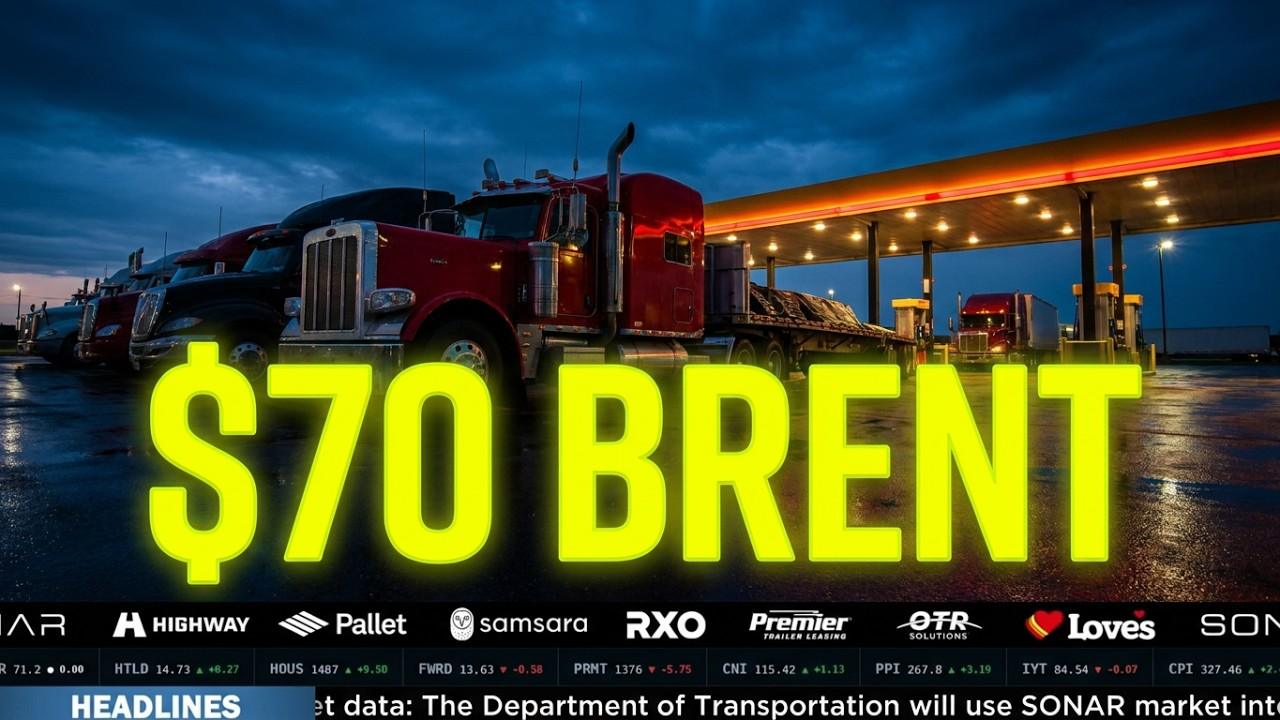
For 2026 budget planning, the analyst recommended shippers and dispatchers assume Brent crude will run roughly $10 per barrel higher than pre-war levels — landing near $70 per barrel — rather than reverting to pre-conflict norms. The International Energy Agency’s June report and Bank of America both projected a significant supply surplus over demand in 2026, driven by increased output from the U.S., Canada, Brazil, and Guyana. The analyst said he is skeptical that surplus will materialize as cleanly as forecasters expect, in part because the Strait of Hormuz closure has introduced a persistent geopolitical risk premium on barrels transiting the waterway.
On the question of whether diesel prices directly drive spot freight rates, both the analyst and a co-host pushed back on the conventional narrative. Spot trucking rates began rising around mid-to-late November, a period when diesel was weak and declining. One co-host noted that during an earlier freight recession, diesel hit a five-year high while rates sat at multi-year lows. The analyst said the two markets run on separate tracks, though he acknowledged that an acute fuel price spike could push marginal owner-operators — who lack fuel surcharge mechanisms available to large carriers — to park trucks, tightening capacity and pushing rates higher.
Carrier financial health remains a concern even as rates climb. The analyst cited reporting from a colleague tracking freight bankruptcies, noting that more insolvency stories are being written now than ever despite the rate recovery, as battered balance sheets from the prolonged freight recession continue to claim operators regardless of the current market upturn.
- Retail diesel dropped to $4.83 per gallon, but Bank of America estimates more than 1 billion barrels of supply have been lost since March, sustained only by inventory draws.
- A tank-bottoms crisis could emerge within 4 to 6 weeks; full production recovery from Iraq, Kuwait, Saudi Arabia, and the UAE may take 3 to 4 months.
- Shippers building 2026 fuel budgets should assume Brent crude near $70 per barrel u2014 roughly $10 above pre-war levels u2014 rather than counting on a significant price decline.
Malcolm Harris [0:00] John, what’s up, sir? How are you?
John Kingston [0:05] Well, really, the question is what’s down. Okay. The price of gas, the price of oil is down. And the Department of Energy, Energy Information Administration, average weekly retail diesel price, which is the basis for most fuel surcharges, dropped below $5 a gallon for the first time since, you know, in a long time. $4.83. The futures market is about where theu2014 about the lowest it’s been. I think it’s probably going to settle out today at the second lowest it’s been since the war started. So I, I’m kind of amazed at this. I will tell you that I, I think that theu2014 it seems the trading community is just completely accepting that everything’s going to be normal, everything’s going to be fine. Uh, you know, we’ve got an agreement that would open up the Strait of Hormuz. We haven’t really even confirmed that the strait is fully open or what the status is. There has been a fair amount of oil that’s been movedu2014 oil and other things that have moved through it. The past couple of days. But I guess I’m just stunned at the total acceptance that everything’s going to be A-okay. And we know that the market has lost roughly aboutu2014 I think Bank of America estimated it more than 1 billion barrels of supply since March. I do not think that there’s been enough demand destruction to offset that. The reason that we haven’t really had a total crisis is because of a massive inventory draw. Those inventories need to be restocked. So I guess I’m just sort of surprised at how complacent and calm everybody seems to be. I might be completely wrong, but I think when you do the math and you add up the lost barrels and you lost thatu2014 and I mean, you know why we haven’t had a calamity? Because we’ve been drawing so hard on inventories. Thoseu2014 that inventory needs to be restocked. And so somebody’s wrong here. It might be me. I don’t trade it for a living.
Julie Van De Kamp [1:51] So I mean, how much time do you think we have left in that inventory? You’ve talked about tank levels in the past and drawdown of that inventory level. What do you think the timing is?
John Kingston [2:03] Well, the timing has always been put by several people, probably like the next 4 to 6 weeks, that if we’re going to have a crisis because we’re at tank bottoms, as the term isu2014 you haven’t really heard that term tank bottoms in a while, but you’ve heard it widely since in recent weeks. That if you’re gonna have a tank bottoms crisis, it’s gonna happen soon.
Malcolm Harris [2:22] Now, John, I wanna ask, when it comes to, I guess there’s 3 scenarios, right? So you have Iran, you have Russia, you have the Gulf amongst other things. What has your eye the most right now, John?
John Kingston [2:36] I would say the eye is about how much oil is gonna get through there. And also I’m gonna be looking for, let’s assume that for a moment the Strait of Hormuz reopens. I’m going to look at the reports from, let’s say, the IEA or from S&P Global Energy, who estimate every month what production is and how much of a bounce back and how quickly the bounce back is going to be from the major producing nations that have had to shut in supply because they had no place to put the stuff. You can’t just turn an oil well back on like flipping a switch. So what’s going to be the long-term impact? Of that. I think that’s something we’re going to have to watch for. That’s going to be for more than 4 to 6 weeks. We’re going to have to see, let’s say, 3 months, 4 months from now, where do we stand? What, what, what have the companyu2014 what have the countries done to get their production up to full? So that would be Iraq, it would be Kuwait. The Saudis, of course, haveu2014 they had their, their own export line through Saudi Arabia that goes over to the Red Sea, a place called Yanbu. Um, the United Arab Emirates also They pulled out of OPEC, so they want to go, go, go. They don’t want any restraints. What are they going to be able to do? So I think that’s kind of the longer-term impact. Now, the Bank of America report that I mentioned earlier, they make the pointu2014 and this was kind of in the International Energy Agency report for June, which came out about a week agou2014 that all the forecasts for 2026 were for a significant surplus of supply over demand. Mostly because of increasing supply out of the US, increasing supply out of Canada, out of Brazil, out of Guyana as a key new source. And their argument, I think, was that they’re predicting maybe $70 average Brent next monthu2014 next year, excuse me, which is a little higher than we were before the war, but not that much higher. And they’re kind of falling back on the idea that the supply-demand balance will probably get back to where it was at the beginning of 2026 when we thought we had a significant surplus. And if so, that’s going to put a large amount of downward pressure on the price. I justu2014 I’m concerned about two things. I’m concerned about, as I said before, the ability of these countries to get their production back up and running. And I’m also concerned about what kind of risk premium the market puts on barrels that have to go through the Strait of Hormuz. It’s been closed once. That’s kind of a sign that it can get closed again. And I don’t think that’s just going to disappear from the market and from the market’s calculation. It shouldn’t.
Malcolm Harris [5:04] That was very, very well said, John. I want to ask, we recently had Jared, of course, with RxO, and some points that were made during his segment today on the show, a lot had to do with spot. We covered that quite a bit. My question for you is, when it comes to spot as well as fuel, how connected Are they right now?
John Kingston [5:26] Uh, not really sure. I would not thinku2014 I don’t really know why they would be connected. One is a cost that they try, they try very hard to pass through. Certainly anybody with a fuel surcharge enables it to pass through. Uh, the spot number obviously was going to be driven higher by, uh, by the cost of fuel, but that’s just a variable on top of it. Ultimately, I think ultimately it’s going to be a supply-demand issue in trucking. And it’s a supply-demand issue on fuel. I would think that the two remain somewhat separate. I wouldn’t say they’re totally separate because if the price of fuel gets too high and an independent owner-operator has less of an ability to pass through that cost because they don’t operate on a fuel surcharge, it’s very difficult for them to, as opposed to somebody like an RXO, as opposed to a major carrier, that independent owner-operator is much more likely to take that truck off the road. So it’s not completely independent, but I don’t know. I think that they’re running on two separate tracks.
Julie Van De Kamp [6:26] I agree. I have very strong opinions about this. I think that a lot of the narrative, because people don’t really understand fuel, is like, yeah, of course rates are up ’cause fuel’s up. So you’re not really netting as much.
Malcolm Harris [6:36] Right.
Julie Van De Kamp [6:39] Regular route one-way trucking is not cost-based. So if your costs go up, it doesn’t really matter. The reality is that because there is lack of capacity, and tender rejections are up, carriers or brokers are able to command a higher rate from shippers right now.
Malcolm Harris [6:57] Yes.
Julie Van De Kamp [6:58] So yes, they can use fuel as a reason for why they’re asking for the high rate. But in a down market, it’s not that even if fuel went up, you’re not going to be able to raise your all-in spot rate because you need the load. Right. So I don’t think that they’re that connected in regards to that. I think people talk about it that way, and I think shippers want to validate their rising costs with carriers by saying it’s fuel. But the reality is it’s all based on supply and demand, as John was saying. But what, what do you think the freight market is reading into the current diesel levels?
John Kingston [7:34] Well, let me just go back for a second. I mean, when do we trace back the current increase in freight rates to around mid-November, late November? Well, the price of diesel wasn’t high then. And in fact, it was kind of it was kind of weak and it was declining really up until the, up until the war started. I’m sorry, what was your next question, Julie?
Julie Van De Kamp [7:51] Well, now I would like, I would say, when was it earlier in the freight recession? And I can’t remember the timeframe, but I got it. I rarely comment on X, but this was one that I did when diesel levels were at their highest that they had been in like 5 years. Rates were still at their lowest.
Malcolm Harris [8:09] Yes, this is correct.
Julie Van De Kamp [8:11] Diesel in the freight market. What do you read on diesel levels? Do you think it’s going to become like, do you think actual diesel levels and tank bottoms, I think is the terminology, are going to have an impact on the freight market and actually change anything here?
John Kingston [8:27] I guess the only thing I’d say is that carrier who’s still kind of, you know, on the margin, maybe a little shaky. You know, my colleague Noi Mahoney, even in this market that’s been soaring, is writing more bankruptcy stories than ever. As Craig has said, balance sheets get battered and just because the freight rates went up doesn’t mean you can get past that bad balance sheet. I would say probably if you get a significant shoot up in prices and maybe supply becomes gettingu2014 I mean, getting this stuff, getting the stuff has not been an issue, that if getting actually material becomes an issue on the margin, you could lose some capacity. So that would probably drive up freight rates even more. So, I mean, you could almost argue you could Depending on how you talk about it, you could almost see a, like an inverse relationship between the two and not necessarily in some ways an inverse relationship, in some ways a tight correlation.
Julie Van De Kamp [9:17] All right, John, we got 30 seconds. If you are a shipper or a dispatcher or whoever planning your fuel budget now for next year, what do you do?
John Kingston [9:27] Well, for next year, I think that you probably assume some degree of normalcy, but I think you still assume, like if you just look at Brent, let’s say, which is the international crude branch benchmark without getting into predicting the price of diesel, just look at the price of Brent and assume that it is going to be higher than it was without a war. That doesn’t necessarily mean $100, but it could probably mean like $70, where given the supply-demand imbalance that was going to be in place in 2026 and probably into 2027, that it’s going to be probably $10 higher, $10 a barrel higher than it might have been without a war. So, you know, all thisu2014 oh, it’s going to come down so much. It’s gonna come down so much. I’m sorry, I just don’t buy that.
Julie Van De Kamp [10:09] All right, thanks, John. I wish we had more time, but we will look forward to having this talk again next week.
The post Freight Fuel Forecast: Is Your Budget Ready for $70 Brent? appeared first on FreightWaves.
Fuente: https://www.freightwaves.com/news/freight-fuel-forecast-is-your-budget-ready-for-70-brent