
(Editor’s note: FreightWaves streamed news and commentary from the arguments before the Supreme Court in Montgomery vs. Caribe II earlier Wednesday. That can be found here).
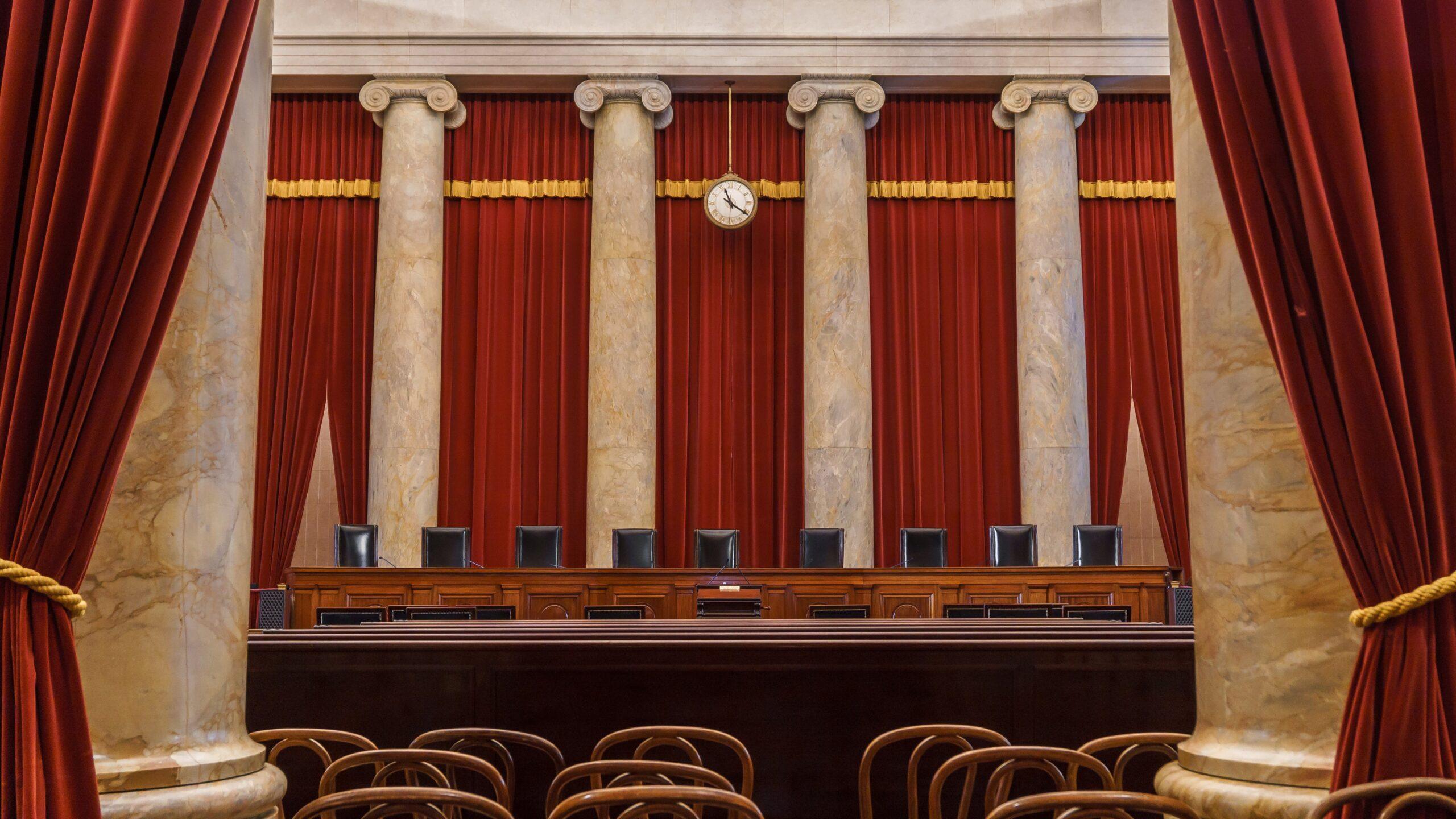
There was a stretch of questioning of Theodore Boutrous during oral arguments Wednesday before the U.S. Supreme Court on Montgomery vs. Caribe Transport II, the possibly groundbreaking case involving broker liability, that very likely made the 3PL community nervous.
Boutrous is the outside counsel for C.H. Robinson (NASDAQ: CHRW), the 3PL that hired Caribe which in turn had a truck that struck and seriously injured truck driver Shawn Montgomery on the side of an Illinois road in 2017. Boutrous, a partner with the Los Angeles office of law firm Griffin Dunn, was taking questions from the judges about his interpretation of the Federal Aviation Administration Authorization Act (F4A), the transportation-focused law from 1994 with sections that could be interpreted to be at odds with each other.
Justice Elena Kagan, who over the course of the roughly 90 minute proceedings sounded largely sympathetic to the idea that brokers could be held liable or negligent for safety issues involving trucks they hired, said she was making an admittedly “simple-minded way of looking at this.”
The question before the court, and the circuit courts whose conflicting decisions led to this seminal moment Wednesday, was whether the safety exception in F4A opened the door to brokers being dragged into a lawsuit arising from a safety-related incident. The safety exception, according to the law, allows state legal action “with respect to motor vehicles” despite another F4A provision prohibiting state action that could impact a “price, route or service.”
The argument being made by Boutrous was that “with respect to motor vehicles” doesn’t rope in brokers. But Justice Kagan expressed skepticism.
“I’m just looking at this provision,” she said. “And you agreed that these tort actions are part of the state’s safety regulatory authority.”
Come on…these are trucks
“So then the question is whether these suits are with respect to motor vehicles,” the Justice continued. “And, you know, come on, how could they not be? They’re all about getting good drivers behind the wheel of a massive truck. That’s with respect to motor vehicles.”
Paul Clement, the former U.S. Solicitor General who argued for the backers of Montgomery’s case–it has not been revealed who is paying the legal bills for the former chief litigator for the Bush administration, who presumably carries a hefty hourly fee–earlier had made a similar argument when he opened up the proceedings.

Brokers and motor vehicles are “quite closely tethered because the whole reason you have a negligent hiring tort is because you’re talking about something that poses a danger of harm to third parties, and the thing that poses the danger of harm to third parties in this context isn’t some brokerage forum.” Clement said. “It’s the 80,000-pound truck.”
Clement’s side was not victorious at the district court level in Illinois or the Fourth Circuit, where C.H. Robinson was victorious in its motion to be removed as a defendant under the provisions of F4A. Montgomery successfully petitioned the Supreme Court for certiorari.
A few minutes after Justice Kagan’s remarks, Justice Ketanji Brown Jackson questioned Sopan Joshi of the U.S. Solicitor General’s office, which is backing the brokerage community’s arguments, expressing some of the same skepticism heard from Justice Kagan.
Congress could have defined it
“Your argument depends, in a way, of us accepting what you’ve said, what Mr. Boutrous said, that brokers are just operating as middlemen, they really don’t have anything to do with safety,” Justice Jackson said. “And I guess we don’t understand why we have to believe that Congress shared that view as opposed to Congress thinking, well, to the extent that brokers are involved in safety, that’s going to come out in the tort suit as a causation issue. And so (Congress) doesn’t really have to take a position on which individual defendants are actually responsible for safety.”
Regulations don’t follow a straight line
There are essentially three moving parts of F4A before the Supreme Court that aren’t in alignment, helping to create the clash of circuit court decisions that led to Wednesday’s deliberations.
One is the preemption clause under a section labeled Motor Carriers of Property that restricts state action impacting a “price, route or service of any motor carrier.” It extends to “any motor private carrier, broker, or freight forwarder with respect to the transportation of property.”
The preemption clause was referred to during the deliberations as Section C. That section has been successfully used by several 3PLs in lawsuits to argue that state action against them could impact a “price, route or service.”
The second is the safety exception, which is a “saving clause” under Section C allowing state action –like a jury verdict–involving a safety incident if it is “with respect to motor vehicles.” C.H. Robinson several years ago found itself on the losing side of a case, Miller vs. C.H. Robinson, where the Ninth Circuit concluded the “respect to motor vehicles” clause could mean a broker.
The issue gets complicated because F4A also has a section B, which deals with intrastate regulation of brokers and freight forwarders. Section B doesn’t have a safety exception.
Section B’s existence led Chief Justice John Roberts to note other justices’ concerns who “don’t quite know why it’s there,” as it is not completely clear what it accomplishes beyond what is in section C, the legal home of the preemption rule and the safety exception.
How B and C go together
Under questioning from Justice Brett Kavanaugh, Clement said the seemingly inexplicable difference does show that Congress “made a very deliberate decision to treat brokers and freight forwarders differently for interstate and for intrastate.”
If the justices were to accept that reasoning, the argument is strengthened that if Congress wanted brokers to be protected from being sued, they would have taken steps to do so in Section B, which deals specifically with 3PLs.
Alina Rosenbaum, an attorney with Public Citizen who has represented plaintiffs that have sued 3PLs and dealt with the reach of F4A said in an interview with FreightWaves that she believes t the lack of straight logic between Sections B and C supported the idea that Congress believed brokers could be sued under the safety exception.
“Congress made the conscious decision to treat intrastate routes, prices and services differently from interstate prices,” she said. “That separateness shows that it wanted interstate services to be subject to the safety exception.”
Or as Clement said in his arguments about the apparent inconsistency between B and C, “it would be…anomalous to take two statutes, one of which has a safety exception and one of which doesn’t, and interpret them to mean the same thing.”
On another issue where Clement faced questioning about the Montgomery position, Justice Brett Kavanaugh raised the issue of carriers being required by federal law to carry liability insurance without a concurrent requirement for brokers. The argument has always been if Congress saw 3Pls as being potentially liable, like a carrier is, it would have required insurance for brokers as well.
“The trucking companies have to have financial security so they can pay judgments with respect to accidents, but they don’t do that on brokers,” Justice Kavanaugh said. “And when you combine the two things we’re talking about, that does — I mean, that’s in tension with your position.”
Clements’ response began with “I think.”
“Congress rationally said we want to make sure that they have a financial security requirement that is responsive to the principal financial risk that they face,” Clements said. “And it’s different with respect to carriers than with respect to brokers.”
Clements said the “principal financial risk” for a broker is default. “You can’t read too much into the insurance requirements because nobody thinks that carriers can’t default,” he said. “In fact, carriers are defaulting all the time.”
Whatever the ruling is, it should clarify the patchwork of circuit court decisions that point in different directions on the issue of broker liability. That need for clarity is considered so great in the brokerage industry that TQL, in the liability case of Gauthier vs. TQL where the brokerage was victorious, took the unusual step of backing the certiorari request of the defeated plaintiff so there could be a resolution of the conflicting circuits. (That certiorari request was denied).
C.H. Robinson speaks
The need for clarity was part of the statement issued by C.H. Robinson after the day’s arguments. ““A single, uniform federal framework is essential to keeping interstate commerce safe, efficient, and consistent with Congress’s design,” Dorothy Capers, the brokerage’s chief legal officer. “Allowing a patchwork of state tort laws to regulate broker services would undermine that system, increase uncertainty, and disrupt the flow of goods Americans rely on every day.”
Rob Moseley of the law firm of Moseley Marcinak law group of Greeneville, S.C., was in the courtroom during the arguments. He said he was “cautiously optimistic” that C.H. Robinson’s arguments would prevail and “we’ll get a favorable preemption ruling.”
“What a broker does is with respect to computers and telephones and not with respect to motor vehicles,” he said.
Asked about her forecast for what the justices might rule, Rosenbaum said: “I don’t like to predict what anyone is going to do.”
More articles by John Kingston
Derek Barrs defends FMCSA’s bold moves at TCA
How New York’s new driving penalties impact truckers
BMO’s quarterly earnings suggest truck credit might be improving
The post Broker liability at SCOTUS: judges debate meaning of ‘motor vehicles’ appeared first on FreightWaves.
Fuente: https://www.freightwaves.com/news/broker-liability-at-scotus-judges-debate-meaning-of-motor-vehicles